You’d Better Behave, Old Lady.
How eight federal vehicles and one man in a reflective vest turned a sensitive writer into an activist.
Back in January, I wrote about my own ICE encounter, before I started interviewing women for my book about the WOMN of the Resistance. It changed me at depth, turning me into an activist. I wanted to share it again here, with that deeper layer of awareness.
THE FROZEN PLACE
On January 7 2026, the earth cracked underneath me, as it did for everyone in Minnesota.
Bam. Bam.
Bam.
Jonathan Ross shot Renee Good three times, and I watched it on a FB video just minutes after it happened.
I lost my breath, and my words.
I know the date because I wrote it down at the top of my journal, and that page in the book stays blank.
My computer cursor blinked at me from my screen for days. Everything I wrote felt frivolous, pointless, pathetic in the face of what was happening in my hometown.
I usually write about learning to breathe, and working through life’s challenges by feeling the feels in the body. But I couldn’t move this giant knot that lodged in my gut, and my throat, and my knees. I could not move the heavy weights that had become my feet.
I felt small and stupid and afraid.
I am a highly sensitive person. I have spent decades tuning the synesthetic orchestra that is my nervous system. And that one moment short-circuited everything. As someone who usually feels and sees and smells the world in technicolor fragrances and symphonies, all I registered for days was a screeching tinnitus of white noise static.
But my dog still needed to be walked. My clients still needed to be heard. My programs still needed to be promoted. My sourdough still needed feeding. So, I went on auto-pilot.
But something was coming.
I didn’t know it yet.
It arrived, January 19th, in a parking lot at sunrise in -4F degrees.
THE ENCOUNTER
It was a Monday.
Tosha started barking as soon as we pulled up to our usual spot. There was a tightness in her voice I’d never heard before.
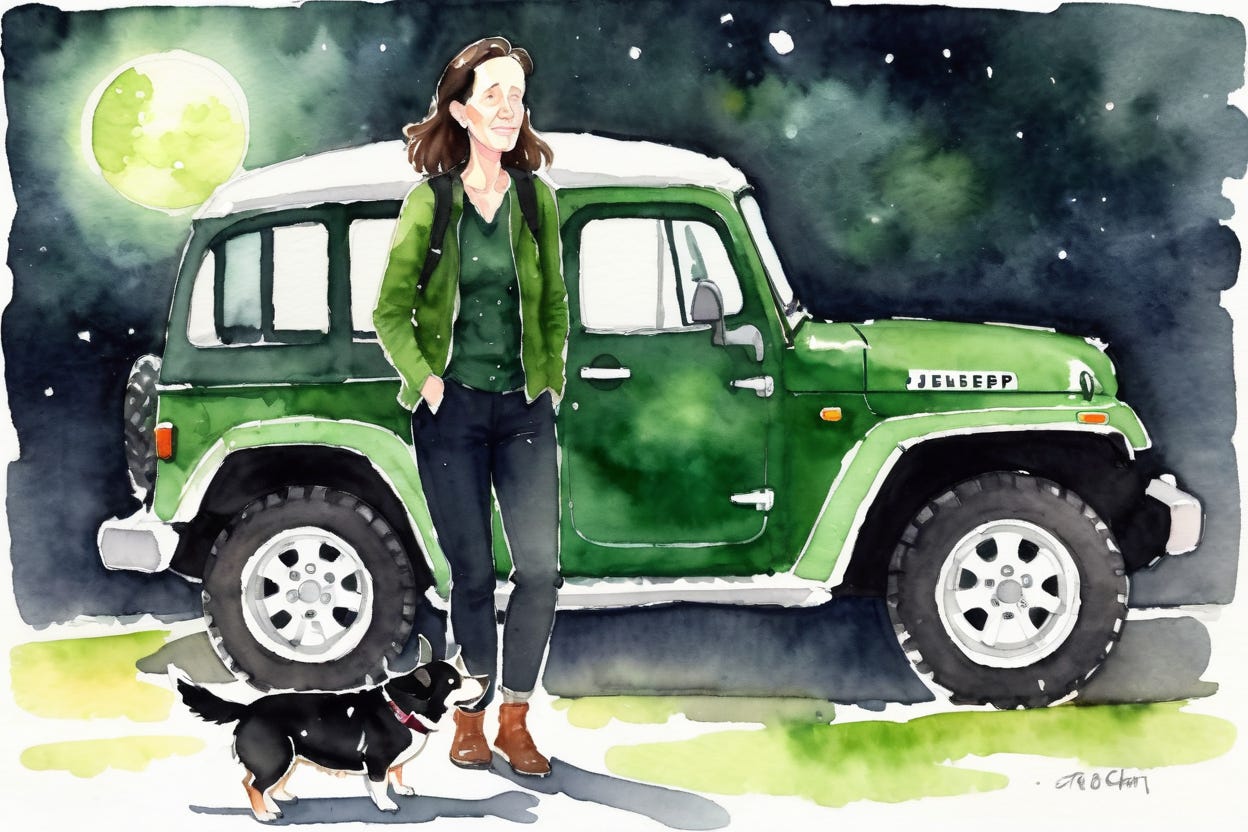
Eight ICE vehicles, a dark green Jeep, several black SUVs, and a grey pickup truck, had backed themselves into parking spaces at angles, taking up two or three spots per vehicle. Lights off, no license plates, engines idling in the early morning moonlight.
As soon as I parked, they pulled out, in formation, and drove behind me and exited the parking lot. Tosha stopped barking, and I exhaled a deep sigh.
I called my husband. If something happened, he needed to know.
A little older man in a reflective vest and neon yellow hat climbed out of a bright blue VW parked near the entrance of the lot and started walking the perimeter. A legal observer, trained to bear witness, to hold space, and to not put himself in the way. He walked slowly, steadily, a full loop of the lot before Jo arrived.
As Jo pulled into the parking lot with her husky/shepherd, Frank, the ICE vehicles followed behind her, all of eight of them. They circled the lot, and parked just as they had been before.
Frank bounded out of Jo’s car, and I was more grateful for his husky-shepherd energy than I had ever been before.
“ICE,” I said, nodding to the vehicles.
“Let’s do the short loop today,” Jo said. We barely spoke the rest of the walk. But we silently agreed, ICE wasn’t going to stop us from living our lives, and we weren’t gonna give them any reason to come after us.
Fifteen minutes later, the six vehicles parked in our aisle pulled out one behind the other. We stepped off onto the snowbank to let them pass.
The rumble of their engines activated my tinnitus into a penetrating squeal. As they approached, driving slower than a walking pace, the vibration peeled off my defense layers, like pulling scar tissue skin from a burn. This is what it’s like to be a highly sensitive person in the middle of a threat. Every sense glitches out at once.
I couldn’t see their eyes or bodies through the darkened windows. On a normal day, I would read body language, facial expressions, auras so I could de-escalate. But I wasn’t dealing with human bodies. . . these were machines, staring me down with headlights in the early morning moonlight.
So I took a cue from Mr. Reflective Vest. I stood tall. I breathed. Mountain pose at minus four degrees on a snowbank with my friend and our dogs. One by one, as they passed, they sped up and looped the lot and re-parked, spreading themselves across three spaces each.
Their message was clear. You’d better behave. And we don’t give a fuck about your dogs.
As we drove out of the parking lot, the little man in the reflective vest got back into his bright blue VW. I sent him a silent thank you as I drove by.
I drove home in silence, thinking to myself, “I am a white woman. I am fully aware of my privilege. This encounter is minor.”
On the drive home, I noticed more reflective vests: a woman wearing a teddy-bear ear ski-cap at the bus stop. A man in a unicorn onesie and a reflective vest at the school crossing zone. A woman with a red-resistance cap at a busy intersection.
In time, I came to realize that the reflective vests far-outnumber the ICE agents.
THE WITNESS ACCUMULATES
I went home and I watched video after video. New ones each day. Old ones recycling with new angles and viewpoints.
I watched them drag a pregnant woman through icy pavement. I watched them hold a man down and spray tear gas directly into his face. I watched them use chemical weapons on an entire North Minneapolis neighborhood sending a family of six children, including a six-month-old went to the hospital. I watched them march a Hmong elder out of his home in his underwear and a blanket.
Every time I thought, it cannot get worse than this.
It kept getting worse.
And the worse it got, the more reflective vests appeared, and more protesters took to the streets, the more helpers offered mutual aid.
And then, on January 21st, the crack under my feet opened up, and I willingly stepped into the hole. I became an activist myself.
As part of a General Strike, no school, no work, no shopping, seventy-five thousand people showed up to the ICEOUT protest marching the streets of downtown Minneapolis in minus twenty degree windchill. I agreed to host a Buddhist Chaplain from Virginia, a man I’d never met in person, so he could participate.
Making up the guest bed for one of the protestors felt like the most important thing I had done in weeks. It was my version of Mr. Reflective Vest’s slow steady loop. With my sensitivities, I couldn’t march with a loud crowd. But I could offer a safe home to someone who could.
Clergy and faith-leaders led resistance actions at the airport, at Renee Good’s memorial, at Target Corporate headquarters, and in smaller venues around the entire metro area. I drove my house-guest to his events, prayed for his safe return, and picked him up at the end of the day.
He told me about 109 clergy and faith leaders at the airport. I pulled up the videos of pastors, rabbis, imams, monks kneeling on concrete in the cold, singing Amazing Grace, as they got arrested one by one. They had a permit for 55 people. They brought 5,000. They knew what they were doing.
In order for protest and civil disobedience to work, it has to be uncomfortable. These people had chosen to be uncomfortable on purpose, in public, on behalf of humanity.
I sobbed a big ugly wet and slobbery wailing cry, emoting sounds I didn’t recognize coming out of myself.
The next day, January 24th, Alex Pretti died.
And I watched it on a FB feed just minutes after it happened.
A guttural explosion of sobs that mixed laughter-like squeals with ear-drum piercing screeches with deep gut-rumbling groans gurgled out of me for more than twenty minutes. It wasn’t just grief for Alex. It was everything — Renee, the pregnant woman, the Hmong elder, the parking lot, the ten days of frozen silence, everything, all at once.
THE AWAKENING
On January 26, I remembered the words of Mr. Rogers. “When I was a boy and I would see scary things in the news, my mother would say to me, ‘Look for the helpers. You will always find people who are helping.’”
My cursor stopped blinking that day. I started writing about the good things happening in Minnesota as a result of all this violence and pain and cruelty. I wrote about the reflective vests, the donut shop turned warming house, the tattoo studio raising $22K in a single day flash sale, the sex-toy store repurposing as a mutual aid donation center. Because the helpers need to be witnessed more than the violence.
I had to find my lane, my way of supporting the resistance, my way of helping.
My lane is lined with words.
Cuz words are spells. . . that’s why we call it spelling.
Every word I choose is charming an energy for the world, my effort to shift a frequency, to soothe a nervous system, to adjust the narrative.
The power I found in my pen is something I didn’t know I had in me, activism. Or perhaps a better word is alive-ism.
Now, I am writing a book.
It grew the way the mutual aid networks grew out of the crisis — organically, necessarily, because the moment demanded it. I am conducting anonymous interviews with the everyday women of Minnesota who are living inside this resistance.
I expected a rabbit-hole venture through grief. But what I am finding in the layers of these interviews is far louder and more hopeful than grief. It is a fierce love for humanity.
I have watched Minnesota become a living, breathing, mycelial network of people choosing each other, again and again, in the cold.
THE REFLECTION
There is a man I think about often. I don’t know his name.
He was wearing a neon yellow hat and a reflective vest on a Monday morning in January, walking steady circles around a parking lot at sunrise, in the cold, making sure I didn’t feel alone.
I didn’t know it then, but in a few short days, I would become him, putting on my own reflective vest for others.
My words– every essay, every note, every good-news dispatch, are the luminaries shining along the path from a state that is bruised and burning yet still bringing hotdish to the neighbors.
When ICE stared me down with their headlights and told me I was small, I got BRIGHT.


I'm 67 and retired. I can't move around like I use to. I try but my knees don't like the cold. My better half and I get out and do what we can. We volunteer at the local dems office in SE Wisconsin and join sign brigades when we can. Our house is festooned with purple lights, protest signs and flags. I read the Substacks daily and have been encouraged to write. I had to give up doom scrolling. It was having a xxx effect on my mindset. I much prefer the hope hunting I do now, daily looking for the good and positive stories. The more I do it, the more the algorithm changes to the better and the calmer and more positive my mind becomes. Hope hunting is how I found you. I look for your Substack every morning. I really don't think you understand just how many lives you have touched. You are the reason our house is lit purple. Don't ever stop!
Fierce Love from a small town in Wisconsin.
I'm in tears reading this.