


“Duck,” Livie says as she taps Carson’s head with the palm of her hand.
“Huh?” Carson says, confused. Livie looks back at him with an equally confused look.
“Duck,” she says flatly again as she taps Brenden’s head.
“What kind of duck?” Brenden says, stopping Livie in her rotation around the circle.
“What do you mean?” Livie stops where she is, halfway around a circle of kids sitting criss-cross-applesauce on the church basement floor. Seven five-year-old faces look up at her, waiting for an answer she doesn’t have.
In the kitchen, watching through the pass-through window, Livie’s mom, Tiffany, sets down the rag and starts for the door. Linda puts a hand on her arm.
“Let them figure it out,” Linda says to her daughter-in-law who is recently transplanted to Minnesota from Anaheim, California, and clearly has never seen a true game of Duck Duck Grey Duck.
“Figure what out?” Tiffany asks, “What game are they even playing?”
“Duck Duck Grey Duck,” Linda says while spraying down the counter.
“Duck Duck What?” Tiffany says, wiping where Linda just sprayed.
“Just watch, you’ll see,” Linda nods to the kids.
Brenden is already up. He steers Livie into his spot on the floor by both shoulders and then walks up behind Maisy, with his hands behind his back, taking his time, looking down at the top of her head the way he’d look into a bakery case.
“Purple duck,” he says, tapping two fingers on top of Maisy’s head and moves on to Carson. He stops behind Carson, tilts his head, thinking.
“Blue duck.”
Carson grins at the floor.
“You’re boring,” Alyssa says, jumping up before Brenden gets to her, waving him off, taking the circle herself.
“It doesn’t have to be just colors,” she says looking back at Livie. “The whole point is to be different.”
She starts with Annalise, looking at her for a good three seconds.
“Sparkly duck.”
“Aw, thank you!” Annalise says as Alyssa pauses behind her best friend Maisy.
“Rainbow duck,” Alyssa says while lifting Maisy’s ponytail up towards the ceiling. Maisy sits up taller with a proud grin.
Behind Winston, her hand comes down, and she is running before she speaks.
“Grey duck!”
Winston scrambles up after her, giggling so hard he can barely keep his feet, and the whole circle turns to follow them around.
Livie watches Alyssa drop into the empty spot where Winston had been sitting.
“What happened to the goose?” Livie asks.
“What goose?” Carson says.
“Geese are mean,” Maisy says.
We Celebrate Differentness
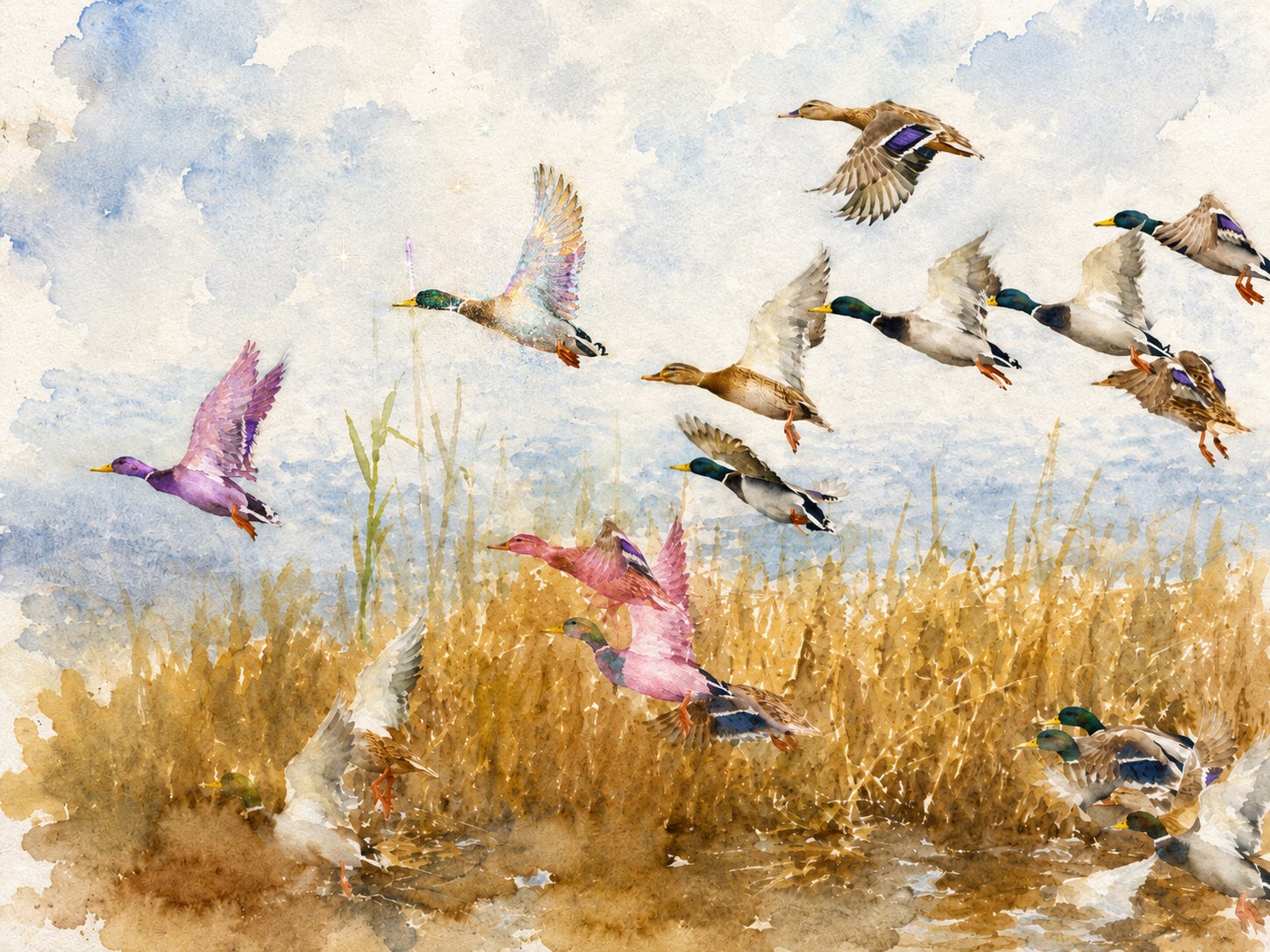
Everywhere in the United States, except Minnesota, children are taught the game Duck Duck Goose, where the emphasis is on sameness. Each child is named as being the same, a simple duck, until the goose is forced to chase its opponent around the circle as a punishment for being different. Be the same as everyone else, and you are safe and get to sit down.
Minnesota doesn’t work that way.
We celebrate differentness.
We play Duck Duck Grey Duck, a version brought here by our Swedish ancestors who called it anka anka grå anka. We lovingly tap and describe every kid on the way around the circle. Pink duck. Blue duck. Polka-dot duck. Sparkly duck. Even dinosaur duck. Being named for what makes us different is the good part — the part we say ‘thank you’ for. Nobody taught Alyssa to say sparkly duck. The game encourages kids to be creative and bring something nobody’s thought of yet.
Minnesota has carried this instinct for valuing diversity into larger choices, including welcoming asylum seekers as refugees. When the Secret War ended and the Hmong who had fought it on behalf of the United Stated needed somewhere to go, Minnesota said come here. When the camps in Thailand emptied, the Karen people came to St. Paul. Somalis, Liberians, Vietnamese, Ukrainians, Ethiopians, Russian Jews, and more. We are a bitter cold flyover state at the top of the map holding one of the largest Hmong communities and the largest Somali community in the country.
For decades, Minnesota’s church congregations have sponsored immigrant refugee families one at a time. Church basement ladies signed up to collect winter coats, meet a plane at four in the morning, and sit at a kitchen table explaining a lease line-by-line. Somebody’s Swedish grandmother taught somebody else’s Hmong grandmother how to work a thermostat. Somebody’s Hmong grandmother taught somebody else’s Swedish grandmother that a garden could hold more than tomatoes, cucumbers, and rhubarb. Fifty years later, much of the produce at our farmer’s markets comes from Hmong farms, and egg rolls sit next to hotdish at every church fundraiser while all the grandchildren sit criss-cross-applesauce on a church basement floor in our sanctuary state.
The Grrrr—een Duck Test
A few rounds later it’s Winston’s turn to be “it”, and he’s taking his time.
Seven kids sit in a circle quietly listening. The only sound is Winston’s steps on the tile.
“Blue duck.”
Two slow steps. Carson tips his chin up before Winston’s hand lands.
“Pizza duck.”
Carson mouths it to himself, pleased.
Winston steps behind Livie and stops. Livie has her hands flat on the floor on either side of her.
“Grrrrrrr—”
He holds it. Across the circle Annalise’s shoulders come up. Brenden’s knee slides underneath him.
Livie tucks both her feet underneath herself into a squat.
“rrr—een duck.”
She sits back down hard. The circle breathes out. Somebody giggles and Livie starts laughing too, at herself, with her hand over her face.
In the kitchen, Tiffany stops wiping the counters and just stands at the pass-through window, watching.
“What just happened?” she asks Linda.
“Winston tested her.” Linda squeezes the spray bottle twice and works at a spot near the sink. “Green and grey start the same. They drag out the grrr on purpose.”
Tiffany watches Livie settle back in. Both hands flat on the floor again. Her head tilted, just so. Tiffany recognizes that face in her daughter, it’s her listening face.
“So they’re all just sitting there listening.”
“That’s most of it,” Linda says. “That, and waiting to hear what they get called.”
Don’t Fuck with Minnesota’s Gaggle of Geese
Two kinds of listening happen in this game. Every kid is waiting for the word that means run. Every kid is also waiting to hear how they are described by the tapper. We can’t listen well while talking, so our kids play the game with keen ears.
Minnesotans, by nature, are a listen-first culture of people, and Duck Duck Grey Duck teaches to be that way at a young age. We let a person finish, and then we leave a pause after they’re finished. We are more comfortable with silence because we like to gather information and turn it over in our minds before we say what we think about it. When somebody new shows up on the block, we are quiet at first, paying attention, carefully contemplating what kind of duck we think they might like to be named.
Inevitably, a native Minnesotan who grew up with Duck Duck Grey Duck will discover as a young adult that other states play Duck Duck Goose instead. This realization usually results in a heated argument about which version of the game is the right one. We Minnesotans will stubbornly refuse to give up our colorful version, arguing about it with your cousin from Ohio at a wedding.
Which is what happened when ICE surged our state.
The feds came here playing a crueler game of Duck Duck Goose with their own made-up rules. They walked around looking for whoever wasn’t the same as them, and when they found them, they made them run, and hide.
We reject their version of the game.
When the feds came for our immigrant neighbors, we showed them how an angry gaggle of geese behaves when protecting its own.

Help keep WOMN alive
I am an independent, self-employed author working full-time to gather, research, and write these stories. There is no publishing house, newsroom, or institution funding the work. This project is structured the way Minnesotans built the response to ICE: from the ground up, with heart, trust, and ordinary people contributing what we can.
A paid subscription keeps me at the desk doing the work. It also adds your voice to the collective message carried by this story:
Our immigrant neighbors belong in our communities. They are part of our lives. When they are torn away, we all feel the wound.
I love you fiercely,
Thanks for giving a shit,
Teri Leigh 💜
When I first left Minnesota as a teenager, I was dumbfounded to discover the rest of the country playing Duck Duck Goose, a mean and simplistic game utterly lacking the finesse and creativity of the game I knew. I'm not normally a dogmatic person, but the superiority of Duck Duck Gray Duck IS the hill I will die on.
Moved from MN to IL in the early 1970s and was so confused by the more boring, less creative Duck Duck Goose version of the game. My brothers and I just shook our heads and eventually acquiesced. I appreciate the deeper meaning you’ve given the original game (especially in light of the regime’s assault on MN) and for sharing the game’s history too.