


WOMN brings readers into the places the headlines never reach.
Come sit in the passenger seat beside Brianna as she grips the steering wheel through a Minnesota white-out blizzard, terrified she will crash but unwilling to turn around because a Venezuelan family hiding from ICE needs food.
This story shows how driving through white-out blizzards prepared us for the “other” kind of ICE, and why we protect our immigrant neighbors as our own, because losing them is like losing a limb of our own.
I am and independent author, self-employed and working full-time to interview women, research what happened, and preserve the stories the headlines left behind. I intend to bring this book into the world the same way Minnesota responded to ICE: grassroots, heart-driven, and sustained by ordinary people showing up for one another. Upgrade to paid and help us bring this book, and this message into the world.

“I’m gonna die!” Brianna yells into her car speakerphone while driving through white-out blizzard conditions.
“You’re okay,” Vox reassures her wife. “You’re a good driver.”
“I’m gonna crash on the highway!” Brianna shouts in a panic.
“You’ve got this,” Vox affirms in that deep grounding voice she knows always works with Brianna. “Just go slow, and pump the brakes.”
“I can’t stop driving,” Brianna asserts. “They need groceries. They have to be able to eat.”
A couple hours earlier, Vox’s dear friend Alejandro, a Venezuelan immigrant, had told her that he was super scared. In the early weeks of the surge, Alejandro’s went into hiding with his cousin’s family. They didn’t reach out for help, but Vox and Brianna knew that the Venezuelan family needed support and they wouldn’t take no for an answer.
With the winter storm warning and Christmas around the corner, the family didn’t know how they’d get through the holiday week as they were nearly out of food. To Brianna and Vox, adding to their Costco order and driving it the 30 miles to the south-of-the-river outer ring suburb was a no-brainer. Their friends needed food, and they had the means to provide.
Done deal.
But they didn’t account for the severe weather winter storm.
Brianna grips the steering wheel and hovers her right foot between the gas and brake pedals.
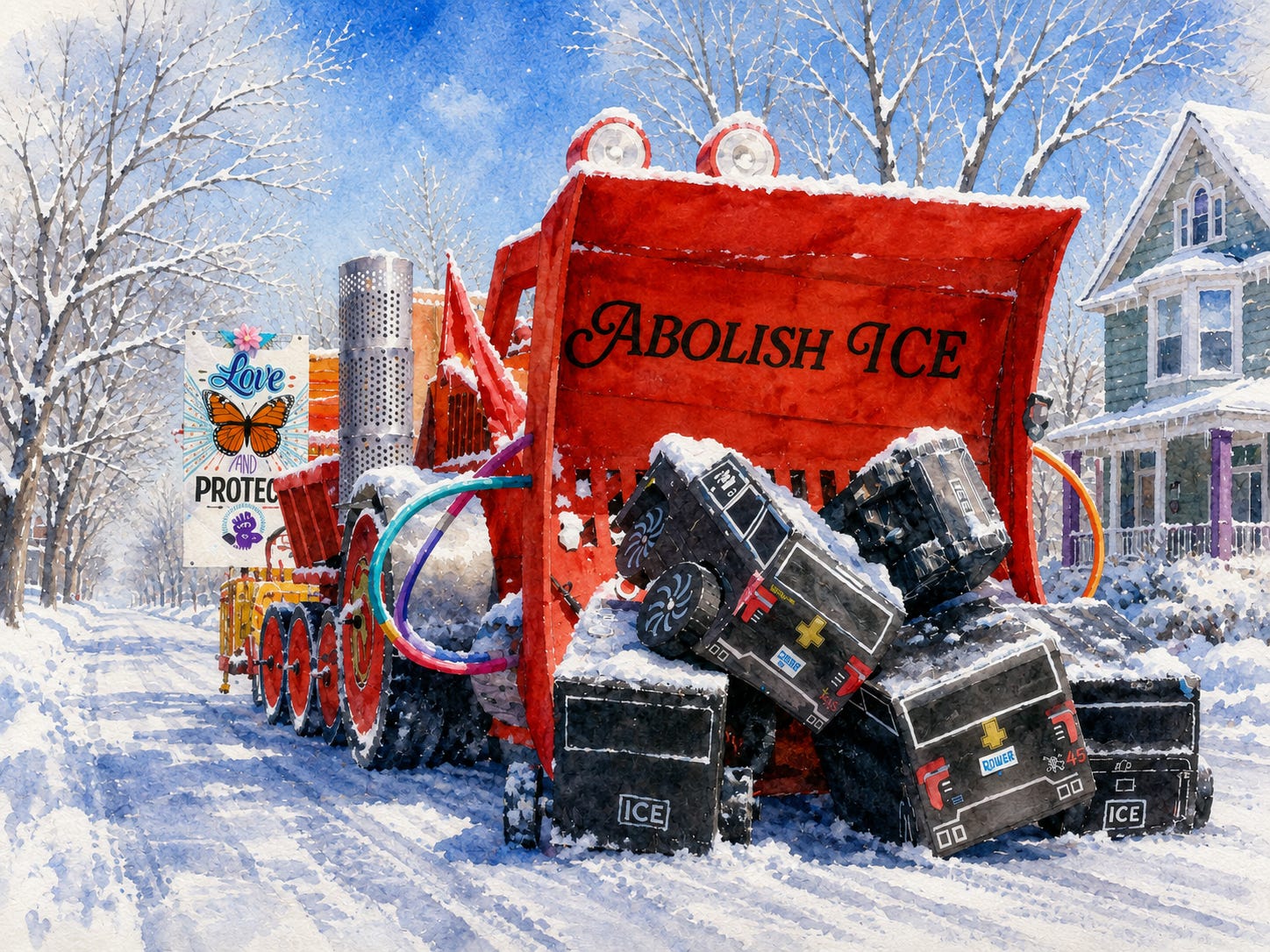
The safest place to be in these kinds of conditions is tucked at home. But home isn’t an option because this family needs food. So, Brianna prays for the second safest option, to be lucky enough to get a few safe car lengths behind a fleet of Minnesota snow plows, aptly named Oh, for Sleet’s Sake, Minne-Snow-ta, and Say It Ain’t Snow.
But that isn’t happening either.
Instead, she settles for driving in the tire-ruts of the slower-than-most semi ahead of her, She curses every idiot who speeds past her as her windshield accumulates and her windshield wipers leave a heavy streak right at her eye-level. Whenever the brake lights flash in front of her, she pumps her brakes, letting her tires slide through the icy patches to avoid fishtailing or side-sliding into the ditch.
What would normally be a 45-minute drive takes two-hours. When she arrives, Alejandro greets her in the driveway that he just finished shoveling and is already covered again.
“Mija! Come in! Come in!” Alejandro insists as Brianna pops her trunk. Before she can start unloading, Alejandro’s cousin is next to her starting to lift Costco boxes out of her trunk. She tells him which boxes are to take as Alejandro rushes her into the house.
The family greets Brianna at the door like she is their own kin, showering her with welcomes and thank yous and taking her coat and scarf before she has an opportunity to insist she just wants to get back home. They have Vox on speakerphone, informing her that Brianna has arrived safely and they are “holding her hostage” until she eats enough arepas to nourish her drive back home.
“Take care of my love,” Vox instructs the family, “that she drove all this way to take care of you, tells you how much she loves me.”
“You’d do the same for me and my people,” Brianna says, and for a timeless moment everyone stops to absorb the fullness of the moment before they hang up the phone and sit Brianna at the table to eat.
“I came to feed you, and here you are feeding me,” Brianna says as she puts her fork down on an empty plate. “Whatever you do to season the meat, um, yeah, and the pastry is perfect. So delicious.”
“That’s how this works,” Alejandro’s cousin says, clearing the plate as his children beg Brianna to play with them. “You must take some home to Vox.”
One month later, Alejandro is kidnapped by ICE.
When he arrived in the states, he crossed the border improperly and immediately went to the immigration office where he was given a valid visa. After being transferred through three different detention facilities with conditions far worse than any prison system, he finally relented and signed self-deportation papers.
Five months later, Alejandro calls Vox from Venezuela. He tells her that the entire experience left him psychologically damaged, but that he agreed to self-deport because they promised him a chance to return one day.
“Why in the world would you want to come back here?”
The question is out of her mouth before she can catch it. And she means it, about her own home.
Help keep WOMN alive
When ICE took Alejandro, it did not take an anonymous immigrant from an anonymous place. It tore the man who called Brianna mija from a living circle and deeply connected community of friendship, family, food, and home.
WOMN exists because these relationships deserve to be remembered.
I am an independent, self-employed author working full-time to gather, research, and write these stories. There is no publishing house, newsroom, or institution funding the work. This project is structured the way Minnesotans built the response to ICE: from the ground up, with heart, trust, and ordinary people contributing what we can.
A paid subscription keeps me at the desk doing the work. It also adds your voice to the collective message carried by this story:
Our immigrant neighbors belong in our communities. They are part of our lives. When they are torn away, we all feel the wound.
I love you fiercely,
Thanks for giving a shit,
Teri Leigh 💜
Thank you wonderful.
Teri, thank you for sharing this beautifully written WOMN story. Loving fiercely, giving a shit. We are all humans. Loving, seeking connection. You illustrated this perfectly. How sad that so many don’t see this.