


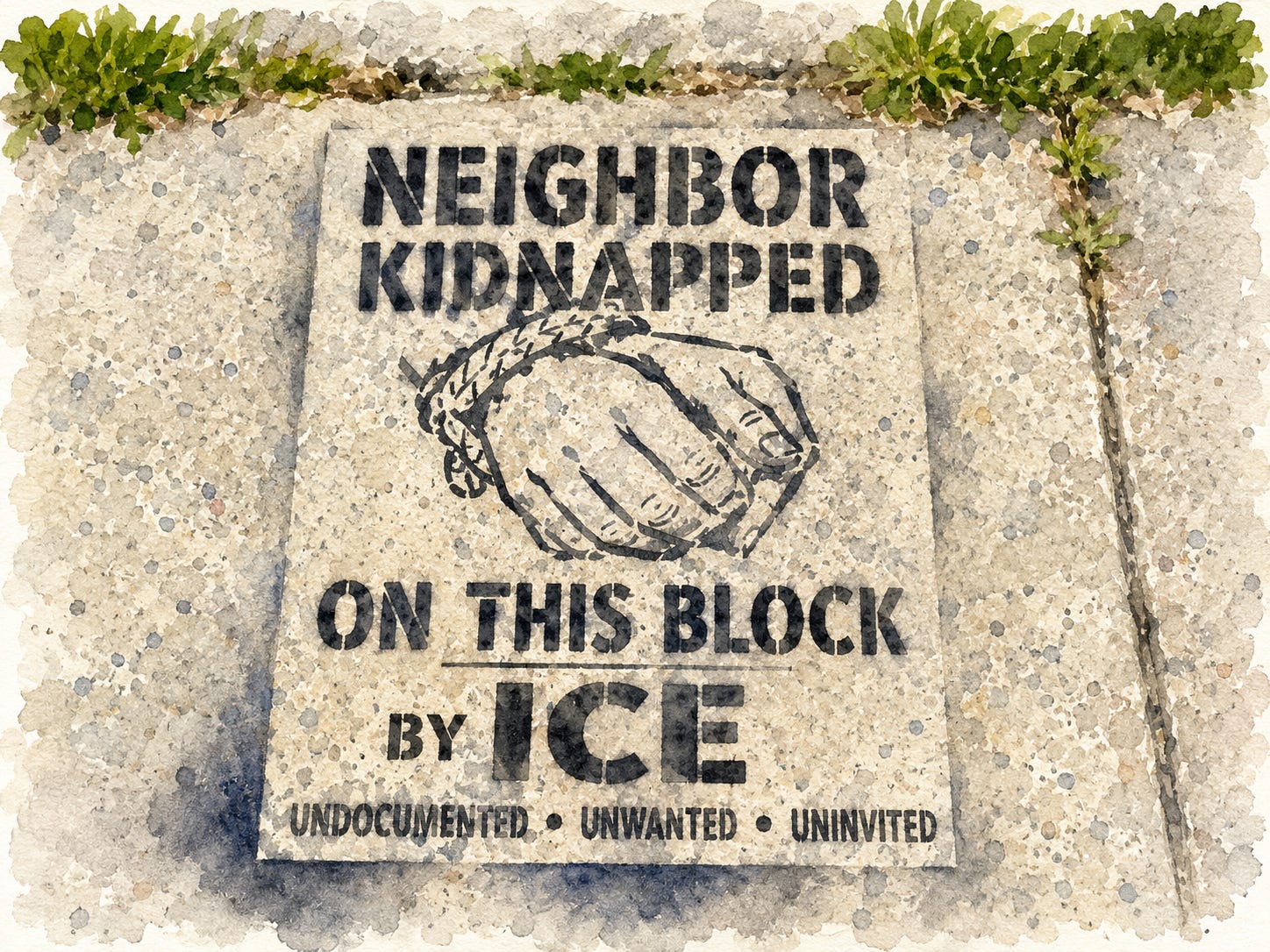
The women I interviewed about Operation Metro Surge in Minnesota confronted their privilege with a clarity they had never experienced before and discovered that the same privilege that had insulated them could also become protection, access, amplification, and power in service to their neighbors.
These are the stories of women who realized that because they had the ability to stand where others could not safely stand, and speak in ways that others could not speak, they also had a responsibility to use that power.
WOMN documents that awakening.
I am an independent, self-employed author working full-time to gather, research, and write these stories. There is no publishing house, newsroom, or institution funding the work.
A paid subscription keeps me at the desk doing the work. It also adds your voice to the collective message from this momentous time in history.

As Sasha steps off the plane and onto the jetway, she switches her backpack to her left shoulder, and then back to her right shoulder, and then decides to loop both her arms through the straps because it would be easier to hug Miguel with both arms free.
But then he would have to hug her backpack and that wouldn’t feel right either.
She finally stops in the middle of the jetway, takes off her backpack entirely and loops its straps over the handle of her rollerbag, balancing the weight of the backpack on the top of the rollerbag.
As she starts to walk again, the backpack tips and sends the rollerbag tumbling off its wheels to the ground. She shakes her head and rolls her eyes at herself. What is she thinking? She still has to go through customs before she can see Miguel.
She’s nervous.
Or maybe she is just overly excited.
She’s never been to Mexico, and she hasn’t seen Miguel since he was kidnapped by ICE and deported several months ago.
And she is pretty sure this is the man she wants to marry, and she’s about to meet his entire family.
The whole time she’s in line for customs, she rehearses her Spanish. For months she’s watched how her home country treats Mexicans. The traffic stops. The home raids. The political sanctions. The beatings and the detainments and the deportations. Her country is the reason Miguel and his brothers are back in their homeland sixteen years later, unable to support their families like they had been for over a decade.
As her turn through customs nears, all she can think is that Mexico has every right to turn away any Americans they please.
She’s so embarrassed.
How is she supposed to prove to Miguel’s family that she is not what her country has been doing to theirs. Who is she to request to be welcomed across their border and sit at these people’s table and ask them to receive her — an American, arriving with an American passport, from the country causing all this harm.
She does not feel owed a welcome.
She doesn’t believe they owe her anything at all. She’s fully prepared to have to earn it — to walk in and somehow show them, in a language she doesn’t speak, that she is not the thing they have every reason to fear.
But the customs and border patrol agent greets her in English before she is even able to say hola. He looks at her paperwork, flips open her passport, stamps it and wishes her a pleasant trip.
That was so easy!
“Gracias,” she says in barely a whisper and loops both her backpack straps over her forearm of one hand and drags the rollerbag with the other towards the automated doors.
Miguel is waiting for her on the other side, flowers in one hand and a welcome sign, in English, in the other.
An hour later, Miguel carries Sasha’s bags into his family home, and his mother greets her with open arms.
“Sasha! Sasha! Sasha! Welcome home. Dis,” She motions around the small living room, “your home now!”
“Our home is your home,” Miguel’s brother says, pronouncing the word “is” with a double long ee and a soft s.
“No hablo Espanol,” Sasha says shaking her head in embarrassment.
At dinner the first night, Miguel’s mother sets a bowl in front of Sasha. It’s dark and slow-cooked, and she cannot even try to name what it smells like. She takes a small bite and her mouth is flooded with flavors she’s never experienced before, in all parts of her mouth. Her whole face lights up in delight, and she looks at Miguel and then his mother and just smiles as she chews.
The whole table laughs, and suddenly they’re all talking at once, passing food to each other and pushing more things toward her. His brother passes her a bowl of something bright red, but Miguel grabs it before she can receive it. He shakes his head and gives his brother a glare. Even though she barely understands the words flying across the table, she has never felt more included in a conversation in her life.
On the last afternoon, Sasha’s bags are packed and Miguel is loading them into the car to take her to the airport. His mother comes running out to the car waving a camera. She wants a photograph of all her kids.
Sasha steps out of the way, but Miguel’s brother, Rafael, grabs her elbow and pulls her in line next to him. Miguel drops her backpack into the trunk and rushes up next to her. She tries to protest, but both men have their arms wrapped around her.
Because Miguel and his brothers have been in the United States, they haven’t all been together for a photo in that long as well. Sixteen years. Sasha doesn’t feel like she belongs in the picture. This is a reunion for the siblings. She tries to say no and pull away one more time, but Rafael holds her tight.
“You’re the reason I’m here,” Rafael says, reminding her that she helped him self-deport before ICE could abduct him.
“You belong in the picture,” Miguel says as he squeezes her waist tighter.
The camera shutter clicks.
Sasha doesn’t move. Miguel and Rafael hold her a second longer than the picture needs, and she lets them. She is in it now, where the family put her, where she is sure she doesn’t belong. But she cannot pull herself away.
As she gets into the car with Miguel and clicks her seatbelt in place after saying goodbye to the family, Sasha looks at Miguel. She’s speechless.
“You’re family now,” Miguel says.
“I thought I was just visiting.”
WOMN is a commercial publishing project, and this work is how I earn my living. The WOMN Project also believes that stories gathered from community should continue to nourish community. Each year, we return some of the project’s resources to Minnesota through mutual aid—sometimes through established organizations and sometimes directly to individuals and families who need help. At the end of each year, we’ll tell you what we gave.
This is such a beautiful story of acceptance, I cried a bit as I read it as all the love shone throughout it.
This is so beautiful, thank you for sharing this. Love is always the answer, and it's damned difficult to see and witness and speak up against the nonstop cruelty. Yet here we are, and if we have privilege in these times, we must know that and use it.