

In writing this book, I am interested in preserving a different kind of historical record, the emotional truths of this time.
During the height of the surge, journalists poured into Minnesota from out of state to tell our story. They stayed for a few days, or maybe a few weeks. But as soon as the surge “drawdown” was announced, they moved on to the next topic in the news cycle, as is their job.
I couldn’t. And I still can’t.
My intention for this book was first and foremost to document the feelings, and that’s what we did. . . because feeling matters.
I am an independent, self-employed author working full-time to gather, research, and write these stories. There is no publishing house, newsroom, or institution funding the work.
A paid subscription keeps me at the desk doing the work. It also adds your voice to the collective message from this momentous time in history.

“HOLY SHIT!”
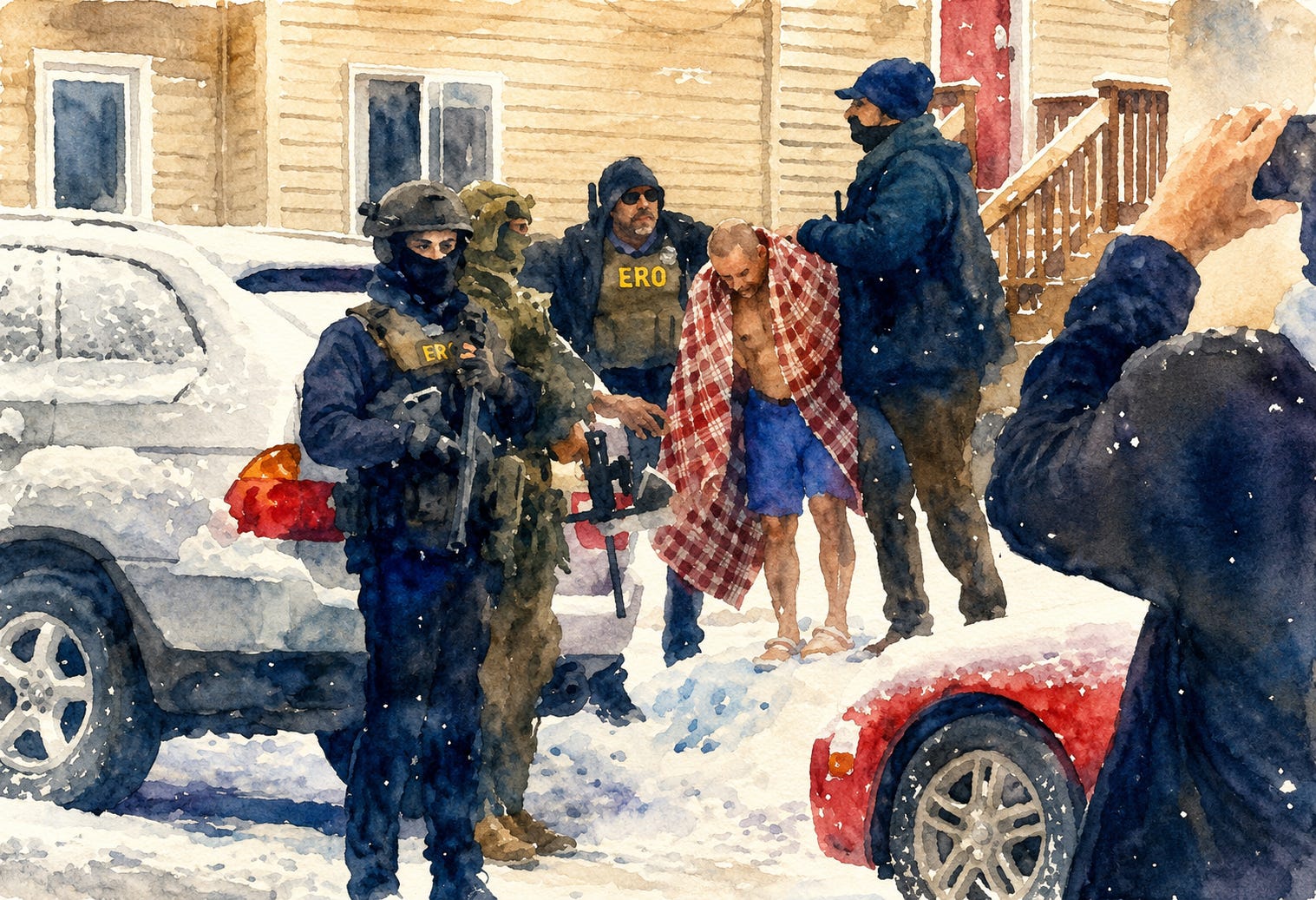
Alice shouts out loud from the couch in her home office as she watches the 15-second reel of ICE marching a half naked Hmong elder out of his home in zero degree snowing weather.
Are you okay?
Alice’s husband texts her from his office in the basement two floors down, having heard her exclamation through the heating vents. She texts him a link to the reel.
The man is ChongLy “Scott” Thao, a 56 year-old Hmong grandfather, a U.S. Citizen, being detained by ICE. He’s wearing boxer shorts, white Crocs, and a red and white fleece blanket thrown over his shoulders. In temps hovering around zero degrees with windchill.
“Why can’t you let him put on clothes!” one of the neighbors yells at the ICE agents.
Alice mutes the volume. Her hyper-sensitive hearing has become even more sensitive lately. The sound of whistles and car horns is both terrifying— ICE is near, and comforting— neighbors are showing up.
She unmutes the video.
“FUCK ICE!” voices yell over the piercing sound of the horns and whistles.
She mutes again.
He’s a Hmong elder.
And then pushes pause, and takes a moment to fully absorb the aura of this gentle elder man. He’s got the tenderness she recognizes in all the Hmong people she has known personally. He reminds her of the father of one of her high school students from her teaching days.
When the surge started, Alice developed a practice of muting and unmuting and pausing and unpausing the reels and videos she watched. It started as a way to protect her sensitive hyperacusis ears from the whistle screams, but evolved into a sort of meditative practice to be more mindful of her doom-scrolling. She can’t stop herself from watching and re-watching the videos, so, she interrupts the scrolling with muting and pausing as miniature moments of silence for herself.
Over time, she recognizes this practice as her way of building an apothecary cabinet corner in her brain for the moments that hit her the hardest. Renee Good has a drawer. Alex Pretti has a drawer. The clergy getting arrested at MSP have a drawer.
Now, this Hmong elder and his fleece blanket in the snow have a drawer.
As she pushes play on the video again and again, she embroiders all the details of his story into an ornate cloth to line the apothecary drawer.
Something about this particular video feels— familiar. She knows the streets and neighborhoods around the Hmong Village and Hmong Marketplace, and suspects this home is near her own home. So, she pauses the video on the frame where she can read the address of the house and google-maps the location. It’s just a few blocks from the duplex where she lived for four years before she moved just a mile away.
I recognize that house, we’ve parked in front of the house many many times to go to Brunson’s.
The block goes into the embroidered cloth, with Brunson’s sign at the end of it.
ICE didn’t serve a warrant when they took ChongLy “Scott” Thao from his home at 1:30pm on that snowy cold Sunday afternoon. They just broke down his door and entered with guns drawn pointed at Thao and his daughter-in-law. Thao’s five-year-old grandson was in the room, crying and terrified, having just woken from a nap.
Alice stitches the boy, still sleepy, into the cloth with a fuchsia flower and green leaves.
Did someone in the neighborhood report him?
Alice had heard rumors that ICE was door-knocking, asking neighbors “where do the Asian people live?” And when Thao was taken, those rumors were confirmed by St. Paul Mayor Kaohly Her, the nation’s first Hmong-American mayor, in a press conference.
She has to find a black thread for this one.
Alice pauses Her’s press conference to double check the lock on her own door and make sure her Ring camera has enough battery charge. She lives in a community that is dense with Hmong neighbors. ICE could come knocking on her door.
If they come, I won’t answer. I’ll just watch them through the Ring and let the dogs bark them away.
Alice sits back on the couch, takes a deep breath, and pushes play on the press conference again.
“I’ve been advised to carry proof of citizenship in my city, where I am the Mayor,” Kaohly Her states before she goes on to explain that her own parents, also U.S. citizens, are afraid to leave their homes.
Her’s voice chokes as she looks right into the camera and explains that this particular ICE abduction is personal for her. ChongLy Thao is a long-time family friend whom she considers an uncle. Her’s mother-in-law knew ChongLy Thao’s mother, Choua Thao, in Laos.
Alice pauses to search the name Choua Thao. She was a nurse at Sam Thong during the Secret War. She helped a Lao woman deliver premature twins. The mother couldn’t care for them, so Choua adopted the boy while another nurse adopted the girl. Choua brought ChongLy to Minnesota in the mid 1970s. They’d been in America fifty years. She had just died on December 26, 2025, and her funeral was planned for February 7-9, 2026.
ChongLy was planning his mother’s funeral when ICE took him.
Alice stitches the Secret War, the adoption, the fifty years, December into her cloth with ornate layered stitches.
She knows there’s more.
Then she hears the teenage giggles of Frank Vue, Moua Vang, and Kou Yang, pulling a thread loose from twenty-five years back. Alice closes her laptop and goes to the closet rummaging for a box of yearbooks buried behind the winter coats.
For four years, the same kids, last names starting with V-Z spent the first twenty minutes every day ignoring school announcements during homeroom. In a mostly white western Wisconsin farm community, Alice’s homeroom was twenty-eight students, all but three of them, Hmong.
Frank Vue is in the second row of the photo, second from the left, smiling a big wide cheesy grin she remembers oh-so-well. He’d grinned that same grin at her that time he forgot his field trip permission slip at home.
“Just let me call them,” Frank said, holding the receiver of the phone on Alice’s desk.
She nodded.
Frank’s mother answered, speaking Hmong. He spoke back in Hmong and then he nodded at Alice.
“Ask her,” he said.
“Does Frank have your permission to go on this field trip?” Alice asked.
“Yes.”
Frank speaks again in Hmong before hanging up.
“She didn’t have any clue what I said, did she?” Alice says.
“Nope. She doesn’t speak a word of English,” Frank says, smiling his big cheesy grin. “So she never understands the paperwork she’s signing anyway. I sign all the permission slips for my sisters and cousins too.”
Alice rolls her eyes.
“Only you, Frank,” she says. “Don’t you dare tell anyone else that I let you do this.”
“I promise,” Frank says forming a cross of his heart with his index finger, “I won’t get you in trouble.”
Frank was the oldest of six in a house with his aunts and uncles and grandparents in it. He ran the school affairs of every child under that roof. He got straight A’s and participated in several extra-curriculars and ran the volleyball club too. His parents named him Frank because they wanted their son to have a name that would keep him from being teased.
In the row behind Frank is Kou Yang, with bunny-ears fingers over Frank’s head and that familiar mischievous grin on his face. Best friends, and opposite characters.
Kou missed a lot of class. When he wasn’t driving his mom somewhere or helping out at the family restaurant, he was ditching class for some adventure he would recount to her in detail the next day. He always turned in just enough work to squeak by with a C-. School was easy for him. He just didn’t care.
Their senior year, they enrolled in a Leadership elective course that Alice taught. The class was a semester-long student organized group project that required leadership within the community. Frank, Kou, and Moua produced a play about a Hmong wedding and funeral. They wrote, cast, directed, promoted the play and coordinated all the behind-the-scenes efforts including booking the venue and donating ticket fees to a local charity.
Moua Vang played the bride, and Kou played the uncle who drinks too much while Frank narrated from the side of the stage, explaining the go-between, the negotiation, the joining of two clans, the offerings to the ancestors. One of the characters dies after the feast, and the play ends with a funeral.
One of the Hmong elders in the audience played the qeej as the other parents and grandparents chanted from their seats. The theater filled with a mournful dirge. Alice sat in the dark theater and cried.
She flips through the entire yearbook and doesn’t find a single picture of the play. There’s no record of it beyond her memory.
Remembering the haunting song of the qeej, she threads the memories of Frank and Kou and Moua into ChongLy Thao’s cloth. A single tear drops from her chin onto her lap.
Alice closes the yearbook, and opens her laptop again to find new reels with different angles of ChongLy Thao’s abduction.
She plays them on mute, reading the captions instead of listening.
He was released without charges.
The Department of Homeland Security said officers were investigating two convicted sex offenders whose last known address was ChongLy Thao’s home.
The family says the men never lived there, and ICE offered no apology and no explanation.
Alice finds the black thread again.
Then she goes back to pause on the frame where he’s mid-step in the snow. He has the same tenderness in his face as Frank’s father had.
The embroidered cloth is bigger than ChongLy Thao now.
She stitches until there’s nothing left she knows.
Alice closes the laptop. The apothecary drawer in the corner of her brain’s memory closes over the cloth.
https://sahanjournal.com/immigration/st-paul-east-side-hmong-man-detained-ice-chongly-scott-thao/
https://www.gofundme.com/f/support-chonglys-family-after-ice-raid-trauma
WOMN is a commercial publishing project, and this work is how I earn my living. The WOMN Project also believes that stories gathered from community should continue to nourish community. Each year, we return some of the project’s resources to Minnesota through mutual aid—sometimes through established organizations and sometimes directly to individuals and families who need help. At the end of each year, we’ll tell you what we gave.
This is another moving essay. This feels so personal, which is part of the reason why this whole project is important.
Thank you for feeling, writing, and sharing.
🙏🌎💙